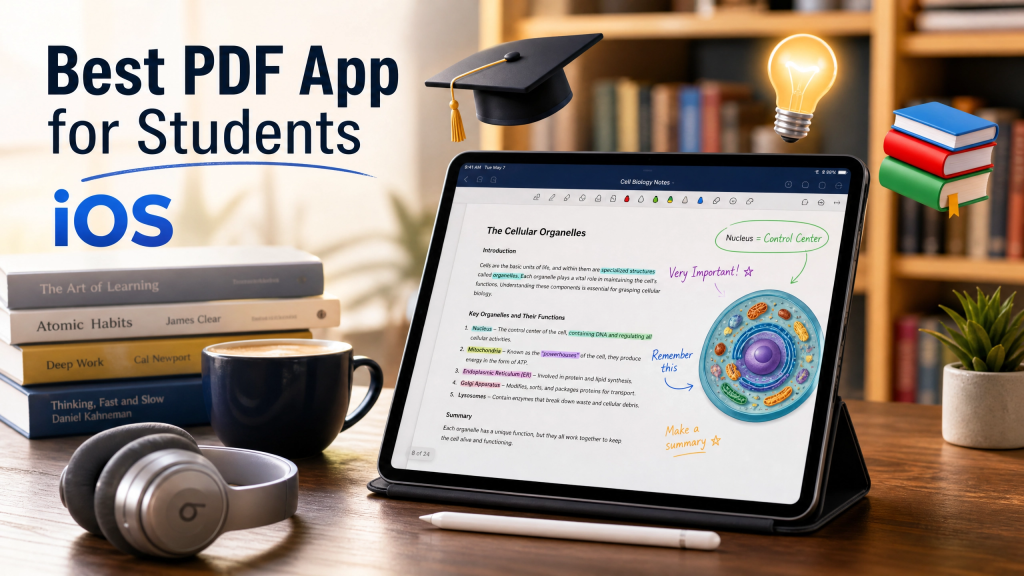
Students today rely heavily on digital documents. From lecture notes and research papers to scanned homework and ebooks, PDFs have become a major part of modern education. Because of this, many iPhone and iPad users search for the best student PDF app that can handle reading, annotation, organization, and sharing efficiently without making workflows complicated.
The ideal PDF app for students should be lightweight, fast, and easy to use. It should also support studying on the go, cloud syncing, and basic editing tools that improve productivity during busy academic schedules.
In this article, we’ll explore what students should look for in a PDF app, why mobile PDF workflows are growing, and how iOS devices are changing the way students manage digital documents.
Features students should look for
A strong student PDF app should include:
- Fast PDF loading
- Smooth scrolling
- Annotation tools
- Highlighting support
- Search functionality
- Cloud synchronization
- Offline reading
These features help simplify study workflows significantly.
Why students use PDFs so often
PDF files are commonly used for:
- Lecture slides
- Homework assignments
- Research articles
- Study guides
- Scanned notes
- Digital textbooks
Universities and schools prefer PDFs because they preserve formatting across devices.
Why iOS devices work well for students
iPhones and iPads have become powerful study tools.
Students now frequently:
- Read notes during commutes
- Highlight textbooks digitally
- Submit assignments online
- Organize files in cloud storage
- Annotate lecture materials
This shift toward mobile learning has increased demand for better PDF apps on iOS.
Annotation tools are essential
Many students regularly:
- Highlight important sections
- Add comments
- Mark assignments
- Write study notes
Annotation tools improve comprehension and organization.
Without annotation support, studying from PDFs becomes far less effective.
Lightweight apps improve focus
Heavy apps often feel distracting because they include:
- Too many features
- Slow interfaces
- Large storage usage
- Excessive popups
Students often prefer lightweight tools that open quickly and focus on reading efficiency.
This article explores why lightweight PDF workflows are becoming increasingly popular on iPhone: lightweight PDF reader for iPhone.
Offline reading matters for students
Internet access is not always reliable.
Offline access helps students:
- Study while traveling
- Read on campus
- Access files during flights
- Review materials anywhere
Reliable offline reading is still one of the most important PDF features.
Cloud storage and academic organization
Students often manage hundreds of documents each semester.
Cloud platforms like:
- iCloud
- Google Drive
- Dropbox
- OneDrive
help organize files across multiple devices.
This also prevents accidental document loss.
Why students increasingly avoid traditional PDF software
Some desktop-focused PDF tools feel:
- Too expensive
- Overcomplicated
- Resource-heavy
- Difficult to use on mobile
Students usually prefer faster and simpler mobile-first experiences.
PDF apps for research workflows
Research-heavy courses often involve:
- Large academic papers
- Scientific PDFs
- Multi-page reports
- Citation-heavy documents
A good PDF app should support:
- Quick search
- Easy bookmarking
- Smooth navigation
- Fast rendering
These small details greatly improve reading efficiency.
Managing scanned notes and handouts
Many students still scan:
- Whiteboard notes
- Printed worksheets
- Handwritten summaries
Good PDF apps help organize and annotate these scanned documents efficiently.
Study productivity and mobile workflows
Modern study habits are becoming increasingly mobile.
Students now frequently:
- Multitask between apps
- Share notes instantly
- Collaborate remotely
- Submit assignments digitally
Efficient PDF management helps reduce friction during busy academic schedules.
Why speed matters in student apps
Students often switch quickly between:
- Lecture notes
- Assignment PDFs
- Research papers
- Presentation slides
Slow apps interrupt workflow and reduce productivity.
Fast loading and responsive navigation matter more than overly advanced editing systems for many students.
QR codes and classroom workflows
QR codes are increasingly common in education environments.
Teachers and event organizers now use QR systems for:
- Sharing class materials
- Linking assignments
- Distributing study guides
- Event check-ins
I started using QR codes more during events and honestly, it saved me a lot of time.
Students can instantly open documents from a QR scan instead of searching through emails or messaging apps.
Best practices for student PDF organization
Create subject folders
Separate:
- Math
- Science
- Literature
- Research projects
Rename files clearly
Avoid generic names like “Document.pdf.”
Backup important assignments
Cloud syncing helps avoid disasters.
Highlight selectively
Too many highlights reduce readability.
Archive completed courses
Keeps current semester materials organized.
Common mistakes students make
1. Keeping all files in Downloads
This quickly becomes disorganized.
2. Ignoring backups
Lost assignments can create serious problems.
3. Using overloaded apps
Heavy apps may slow older devices.
4. Forgetting offline access
Important for travel and unreliable Wi-Fi situations.
5. Overcomplicating workflows
Simple systems are usually easier to maintain.
Why minimal interfaces help studying
Clean interfaces reduce distractions and improve focus.
Students often study more efficiently when apps:
- Open quickly
- Display documents clearly
- Avoid cluttered menus
- Simplify navigation
Minimalist design is becoming increasingly popular in education-focused productivity tools.
Future trends in student PDF apps
Future PDF tools may include:
- AI-powered summaries
- Smart note organization
- Voice annotations
- Automatic citation extraction
- Collaborative study features
Mobile learning tools will likely continue evolving rapidly.
Final thoughts
Choosing the right student PDF app can dramatically improve study efficiency, organization, and productivity on iOS devices. Students today need fast, lightweight, and reliable PDF tools that support annotation, offline reading, and cloud organization without unnecessary complexity.
A simple mobile-first workflow often works better than overloaded desktop-style software, especially during busy academic schedules.
Some students who regularly work with digital notes and study PDFs also come across tools like ScanNova PDF Tools during their daily document workflows.
Apps focused on lightweight mobile PDF reading and organization are also becoming increasingly common across iPhone study environments, including tools like PDF Reader for iPhone


Leave a comment